
Operational bottlenecks don’t appear out of nowhere. They’re created quietly, order after order, every time a decision has to be made manually or a process depends on a person noticing something at the right moment. For many teams, the real issue isn’t workload — it’s decision load. The more choices an operations team has to make throughout the day, the more friction accumulates until it becomes a recognizable bottleneck.
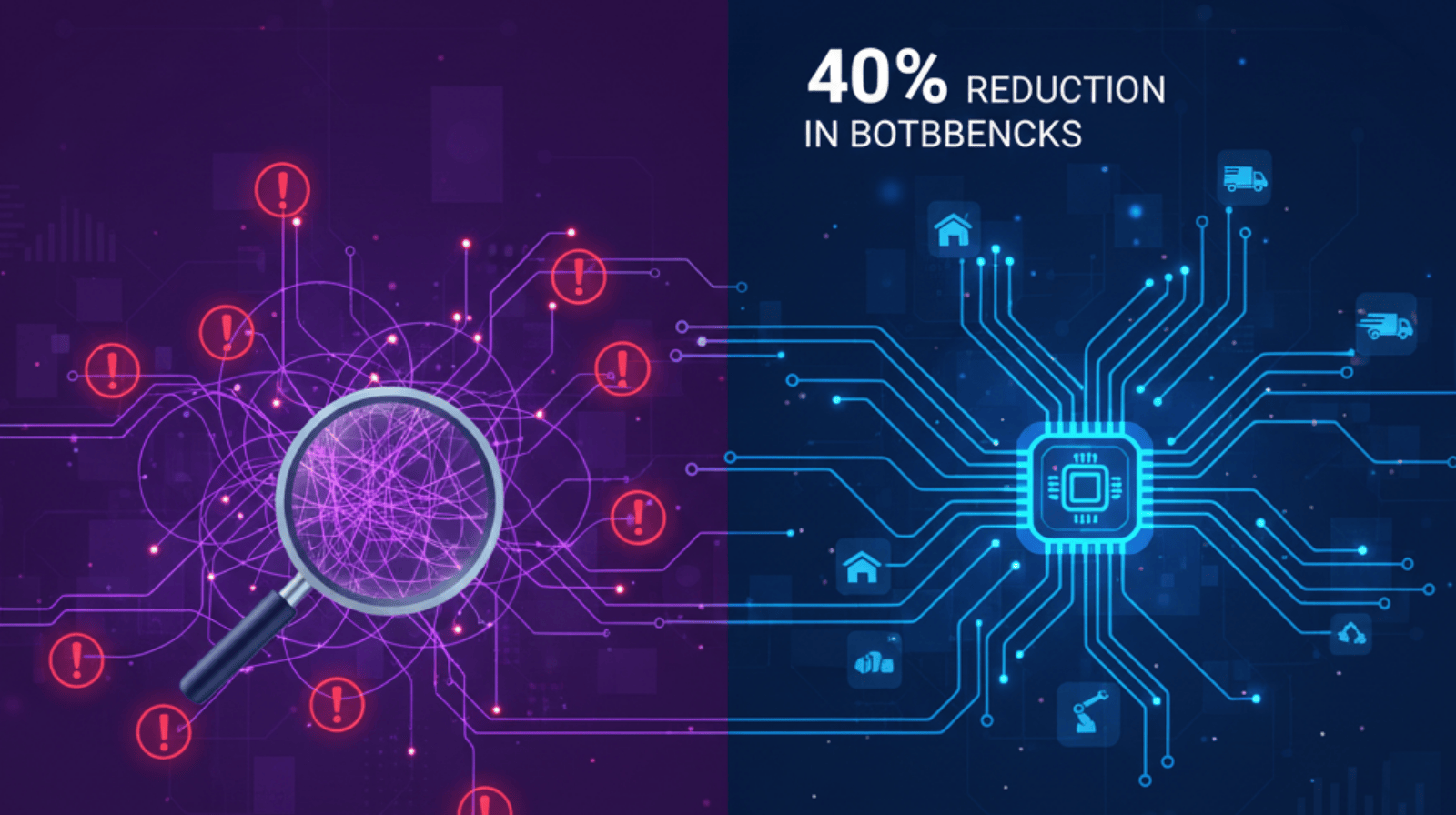
Smart order routing reshapes this dynamic entirely. Instead of relying on constant monitoring or case-by-case judgment, it builds predictable pathways for every type of order. When routing logic becomes intelligent and automated, teams experience fewer interruptions, fewer exceptions, and fewer last-minute escalations. The result is a measurable reduction in operational slowdowns — often by as much as 40%, according to industry benchmarks.
Why Routing Is the Hidden Source of Operational Delays
Most operational bottlenecks happen between steps, not within them. The moment an order needs to be validated, assigned, rerouted, flagged for attention, or moved to another team is where delays stack up. These handoff zones are where humans often fill the gap, making small decisions that collectively consume hours of attention every week.
Examples include:
• Choosing the right warehouse or fulfillment location
• Handling incomplete or mismatched addresses
• Assigning priority levels
• Determining shipping methods
• Flagging orders that require manual review
• Coordinating exceptions across teams
When each of these decisions requires a human touch, the process becomes vulnerable to volume spikes, absence, inattention, or shift changes. Smart routing removes the dependency on individuals by embedding decision logic directly into the workflow.
Turning Decision Points into Automated Logic
Smart routing doesn’t eliminate human insight — it codifies it. The best operational teams study their decision patterns, identify what consistently triggers certain actions, and turn those patterns into rules.
That might look like:
• Automatically routing high-value orders for priority processing
• Sending risky or mismatched addresses into a validation queue
• Selecting carriers based on destination, cost, or SLA
• Splitting shipments intelligently when stock is distributed
• Routing international orders through specific operational paths
• Redirecting orders when a warehouse is at capacity
When this logic runs in the background, the workflow becomes clearer and faster. Teams are no longer responsible for noticing or remembering — the system does it for them.
Reducing Exceptions Before They Disrupt the Workflow
One of the most underestimated benefits of smart routing is how it reduces unplanned work. Exceptions — the orders that don’t follow the normal path — are what slow teams down the most. Address errors, stock issues, payment discrepancies, and carrier restrictions often sit undetected until a human spots them.
With smart routing, exceptions are recognized on arrival and automatically placed into the right path. This prevents them from clogging the main workflow and allows the team to handle issues in a controlled, organized way. Instead of turning into urgent tickets or customer complaints, exceptions stay contained.
This single shift is often responsible for a dramatic drop in operational bottlenecks.
Creating Predictability Across Teams
Predictability is the cornerstone of scalable operations. When teams know exactly where orders will move, what rules guide them, and which scenarios require attention, the entire workflow becomes easier to manage.
Smart routing creates this predictability by ensuring that:
• Orders follow consistent logic, not subjective interpretation
• Priorities are always aligned with business goals
• Team members spend less time “checking” and more time executing
• Handovers happen cleanly, without ambiguity
• Workloads distribute more evenly across the day
This level of consistency significantly reduces operational stress. It also makes training new team members faster, since the system carries a large portion of the decision-making weight.
Supporting Multi-Channel Complexity Without Adding Chaos
Today’s ops teams rarely manage a single source of orders. They’re juggling storefronts, marketplaces, wholesale flows, manual inputs, and B2B requests — all with different rules and constraints.
Smart routing acts as the “traffic controller” that keeps complexity contained. Regardless of where orders originate, they enter a unified logic system that ensures every order receives the appropriate path. This is crucial for avoiding bottlenecks when volumes spike due to promotions, seasonal peaks, or sudden channel expansion.
A scalable routing system makes growth smoother instead of more chaotic.
How Mailorder Supports Teams
Mailorder was designed around the idea that operations shouldn’t rely on constant supervision. Smart routing is one of the ways teams using the platform reduce friction in their daily workflows. By centralizing decision logic, surfacing exceptions early, and automating order movement, Mailorder allows teams to operate with fewer interruptions and far more consistency.
The platform isn’t meant to replace operations — it amplifies the workflow teams already know. And for companies dealing with multi-channel complexity or rising order volume, this kind of routing logic often becomes the backbone of smoother, faster fulfillment.
Interested in Optimizing Your Routing Logic?
If smart order routing could simplify your daily operations or reduce bottlenecks in your fulfillment flow, we’d be happy to explore it with you.
Reducing bottlenecks isn’t just about working faster — it’s about building workflows that don’t slow down as you grow.